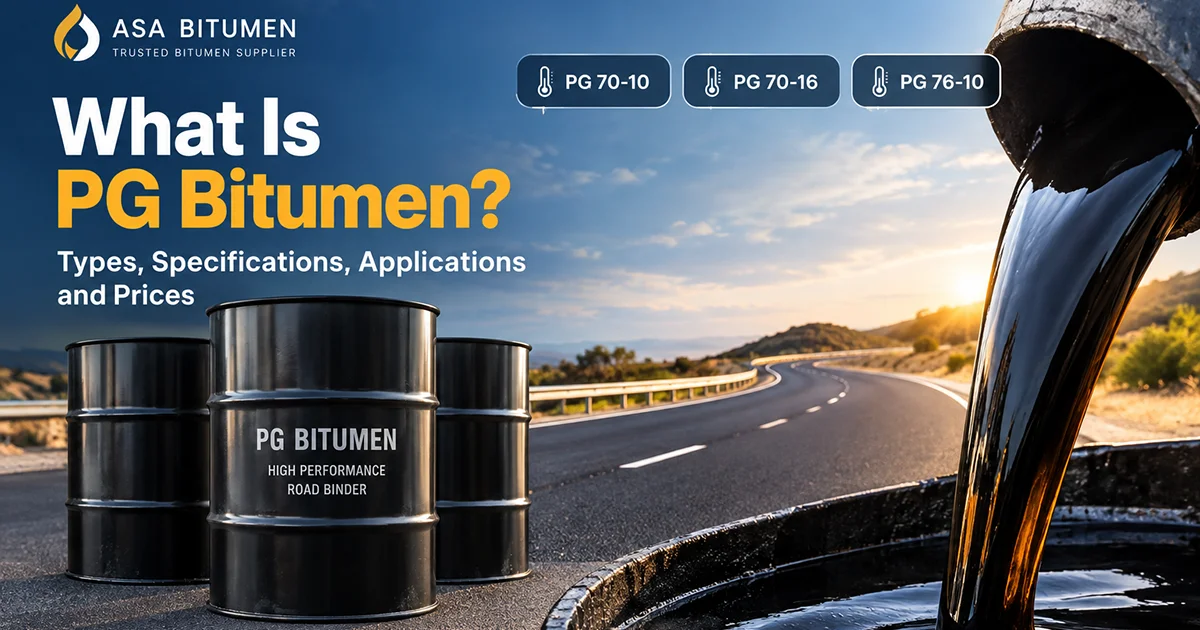
What Is PG Bitumen?
PG Bitumen, also known as Performance Grade Bitumen, is an asphalt binder classified according to its performance under specified high and low pavement temperatures.
It is widely used in modern road construction projects where climatic conditions, traffic loading and long-term pavement durability are important considerations.
Unlike conventional Penetration Grade Bitumen, which is primarily classified according to its hardness at 25°C, Performance Grade Bitumen is evaluated through performance-related laboratory testing at different temperatures.
The PG grading system was developed through the Strategic Highway Research Program (SHRP) and the Superpave asphalt technology program. It is specified under internationally recognized standards, including AASHTO M 320 and ASTM D6373.
The main objective of PG Bitumen is to help engineers select asphalt binders capable of meeting the temperature-related performance requirements of a particular pavement.
Today, Performance Grade Bitumen is increasingly relevant to road construction projects in Africa, the United Arab Emirates and other international markets where high pavement temperatures, heavy commercial traffic and demanding operating conditions require careful binder selection.
At ASA Bitumen, our approach to Performance Grade Bitumen goes beyond supplying a particular asphalt binder. Selecting the correct PG grade requires a combination of technical understanding, project specifications, commercial evaluation and reliable international logistics.
ASA Bitumen supports international buyers sourcing PG 70-10, PG 70-16 and PG 76-10 for road construction, asphalt production and infrastructure development projects.
Understanding the Performance Grade Bitumen System
Traditionally, paving bitumen has been classified through two commonly recognized systems: Penetration Grading and Viscosity Grading.
Penetration Grade Bitumen measures binder consistency through needle penetration at 25°C, while Viscosity Grade Bitumen classifies the material according to its viscosity characteristics at specified temperatures.
Although these grading systems remain widely used in international bitumen trading, they do not fully describe how asphalt binders behave across the temperature conditions experienced by a pavement.
This limitation became particularly important as highway engineers investigated pavement failures associated with rutting, fatigue cracking and thermal cracking.
Through the SHRP research program, engineers developed the Performance Grade system to evaluate asphalt binder properties under more realistic pavement temperature conditions.
The resulting Superpave grading system introduced a more comprehensive method for selecting bitumen based on performance-related characteristics.
For international bitumen importers and road contractors, this means PG Bitumen provides a more detailed technical basis for product selection than conventional hardness or viscosity measurements alone.
How Does PG Bitumen Grading Work?
Performance Grade Bitumen is identified by two temperature values.
For example:
PG 76-10
The first number, 76, represents the high pavement design temperature in degrees Celsius.
The second number, -10, represents the minimum pavement design temperature in degrees Celsius.
The high-temperature designation is traditionally associated with the average maximum pavement temperature over seven consecutive days, while the low-temperature designation relates to the minimum pavement design temperature.
These values represent pavement temperatures rather than ordinary air temperatures.
This distinction is particularly important in hot climates because asphalt pavement temperatures can be significantly higher than the surrounding air temperature.
For example, a PG 76-10 binder is specified to satisfy performance-related requirements associated with a high-temperature grade of 76°C and a low-temperature grade of -10°C.
However, the PG designation alone does not guarantee that an asphalt pavement will remain free from rutting or cracking.
Traffic loading, asphalt mixture design, aggregate quality, pavement structure and construction methods also influence long-term pavement performance.
Common PG Bitumen Grades and Their Applications
Performance Grade Bitumen is available in different classifications to satisfy specific pavement design requirements.
ASA Bitumen focuses on international supply inquiries involving PG 70-10, PG 70-16 and PG 76-10.
Bitumen Performance Grade | PG 70-10
PG 70-10 is designed for paving applications requiring a high-temperature performance grade of 70°C and a low-temperature designation of -10°C.
It is particularly relevant to hot-climate road construction projects where resistance to permanent deformation is an important engineering consideration.
Potential applications include highways, urban roads, industrial access roads and asphalt paving projects with compatible design requirements.
For international buyers, PG 70-10 can provide a performance-based specification when traditional penetration grades do not adequately describe the project’s binder requirements.
Bitumen Performance Grade | PG 70-16
PG 70-16 maintains the same high-temperature designation as PG 70-10 while extending the low-temperature performance designation to -16°C.
It may be suitable for projects experiencing greater seasonal temperature variation or requiring additional low-temperature performance.
PG 70-16 can be considered for highways, urban infrastructure and other paving applications where the engineering specification requires this temperature range.
Bitumen Performance Grade | PG 76-10
PG 76-10 is a higher-temperature performance grade intended for demanding pavement conditions.
Its high-temperature designation of 76°C makes it relevant to projects where elevated pavement temperatures and resistance to rutting are particularly important.
Potential applications include heavily trafficked highways, industrial transport routes and major infrastructure projects.
Depending on the technical requirements, PG 76-10 may be produced using suitable modified or unmodified binder formulations capable of meeting the specified performance criteria.
Buyers should always review the complete laboratory results rather than relying exclusively on the grade designation.
How to Choose the Right PG Bitumen for Road Construction
Selecting Performance Grade Bitumen requires more than choosing the highest available temperature grade.
Based on more than 11 years of experience in international petroleum and bitumen trading, we believe that one of the most common purchasing mistakes is selecting a bitumen grade based solely on price or supplier recommendations without reviewing the actual pavement requirements.
At ASA Bitumen, we recommend evaluating five essential factors before confirming a Performance Grade Bitumen order.
- Pavement Temperature
Determine the expected maximum and minimum pavement design temperatures at the project location.
- Traffic Conditions
Consider traffic volume, heavy axle loads, slow-moving vehicles and repeated loading conditions.
- Project Specifications
Review the applicable road authority requirements, engineering consultant’s specifications and referenced international standards.
- Binder Performance
Evaluate rutting resistance, low-temperature behavior, aging characteristics and any additional performance requirements.
- Total Project Cost
Consider not only the FOB bitumen price but also packaging, freight, insurance, handling and the overall cost of delivering the required binder.
The correct PG grade is not necessarily the most expensive grade. It is the grade that satisfies the project’s technical requirements at a commercially reasonable total cost.
PG Bitumen for Road Construction in Africa
Africa represents an important market for international bitumen trading, with demand associated with highway construction, road rehabilitation, industrial infrastructure and urban development.
However, the continent includes significantly different climatic and geographic conditions.
A coastal road in East Africa may require a different binder specification from a highway in an elevated inland region.
For this reason, bitumen importers should avoid selecting PG grades based solely on country or regional temperature averages.
PG Bitumen Supplier for Kenya and Tanzania
Kenya and Tanzania are important markets for imported bitumen and road construction materials.
Projects around Mombasa and Dar es Salaam can experience demanding temperatures, while inland and elevated locations may have different pavement design conditions.
PG 70-10, PG 70-16 and PG 76-10 may be evaluated where their specifications match the engineering requirements.
For importers, shipping arrangements through ports such as Mombasa, Dar es Salaam and Tanga are also important commercial considerations.
The final purchasing decision should account for both technical compliance and delivered cost.
PG Bitumen for Nigeria and West Africa
Nigeria is a significant market for road construction, asphalt production and infrastructure development.
High pavement temperatures and heavy commercial traffic can increase the importance of selecting binders with suitable resistance to permanent deformation.
For contractors and importers serving Lagos, Abuja, Port Harcourt and other Nigerian markets, higher-temperature PG grades may be relevant depending on the project specification.
Buyers importing through Lagos or Apapa should also consider packaging, freight availability, port handling and delivery schedules when comparing suppliers.
PG Bitumen for Mozambique, Uganda and Southern Africa
Projects in Mozambique, Uganda, Zambia, Zimbabwe and neighboring markets can involve widely varying climatic conditions.
Coastal roads, elevated highways and industrial transport corridors may require different binder properties.
ASA Bitumen supports international inquiries from these markets and can review technical requirements alongside suitable export and shipping arrangements.
The objective is to help buyers select a compliant product while maintaining a practical and competitive supply plan.
Commercial Considerations for African Bitumen Importers
From ASA Bitumen’s commercial perspective, African bitumen procurement requires a balance between technical compliance, product availability and logistics efficiency.
A competitive FOB quotation alone does not guarantee the best purchasing outcome, particularly for shipments to East and West African destinations where ocean freight, insurance and port handling can significantly affect the final landed cost.
For African road contractors and distributors, supplier reliability and shipment planning can be just as important as the quoted product price.
PG Bitumen Supplier in Dubai and the UAE
The United Arab Emirates is an important regional center for bitumen trading, infrastructure development and international logistics.
Road projects in Dubai, Abu Dhabi and other Gulf locations can experience demanding pavement temperatures, particularly during summer.
For these applications, Performance Grade Bitumen such as PG 70-10 and PG 76-10 may be considered where the relevant road authority specifications require their performance characteristics.
However, the grade must be selected according to the actual project design rather than simply because the project is located in a hot country.
ASA Bitumen supports international buyers through its commercial presence in Dubai, offering technical inquiries, commercial quotations and export coordination.
For buyers searching for a PG Bitumen supplier in the UAE, our focus is on combining suitable technical specifications with reliable commercial execution.
PG Bitumen vs Penetration Grade Bitumen 60/70
One of the most common questions in international bitumen trading is whether PG Bitumen can replace conventional Penetration Grade Bitumen 60/70.
The answer depends on the technical specification.
Penetration Grade 60/70 is classified according to the depth of needle penetration at 25°C, indicating the binder’s consistency under standardized test conditions.
Performance Grade Bitumen is classified through performance-related properties evaluated at different temperatures and aging conditions.
These two systems measure different characteristics.
Therefore, Bitumen 60/70 cannot automatically be considered equivalent to PG 70-10, PG 70-16 or PG 76-10.
A 60/70 binder may satisfy a particular PG specification, but this must be established through the required laboratory testing.
For contractors and importers, substituting one classification for another without technical verification can create quality and contractual risks.
Difference Between PG Bitumen and VG Bitumen
Viscosity Grade Bitumen is classified primarily according to binder viscosity at specified temperatures.
Common grades include VG10, VG20, VG30 and VG40.
The viscosity grading system is widely recognized in markets where road authorities use conventional viscosity-based specifications.
PG Bitumen, by comparison, uses rheological properties and pavement design temperatures to assess performance-related characteristics.
For example, VG30 and PG 70-10 should not be treated as directly interchangeable grades.
Even when conventional test results appear similar, the binders may respond differently under performance-based testing.
For international procurement, the safest approach is to follow the exact grade and standard specified by the project owner or engineering consultant.
Is PG Bitumen the Same as Polymer Modified Bitumen?
No. Performance Grade Bitumen is a classification system, while Polymer Modified Bitumen refers to a binder containing polymer modifiers.
Some PG grades can be achieved using unmodified bitumen, while others may require modification depending on the base binder and performance requirements.
Polymer modification may improve selected properties such as elastic recovery and resistance to permanent deformation.
However, a high PG designation does not automatically prove that the binder is polymer modified.
Similarly, the numerical difference between the high and low PG temperatures is not a definitive method for identifying polymer modification.
Where polymer modification is required, buyers should request the relevant formulation information, technical specification and supporting test results.
For demanding traffic conditions, additional performance testing may be necessary.
PG Bitumen Tests and Technical Specifications
Performance Grade Bitumen is evaluated through laboratory procedures designed to measure its behavior at different temperatures and after simulated aging.
The most important tests include:
Dynamic Shear Rheometer (DSR) — AASHTO T 315
Measures rheological characteristics relevant to binder stiffness, deformation and performance under loading.
Rotational Viscometer (RV) — AASHTO T 316
Measures viscosity at elevated temperatures and provides information relevant to handling and asphalt production.
Bending Beam Rheometer (BBR) — AASHTO T 313
Evaluates low-temperature stiffness and relaxation properties associated with thermal cracking.
Rolling Thin-Film Oven Test (RTFOT) — AASHTO T 240
Simulates short-term aging during asphalt mixing and construction.
Pressure Aging Vessel (PAV) — AASHTO R 28
Simulates longer-term oxidative aging to support evaluation of binder properties during service.
Direct Tension Test (DTT) — AASHTO T 314
Evaluates low-temperature tensile properties when required by the applicable specification.
Additional tests, including elastic recovery, storage stability and Multiple Stress Creep Recovery (MSCR), may be required depending on the project specification.
AASHTO M 332 incorporates MSCR testing and traffic-related binder classifications, making it particularly relevant to demanding traffic applications.
For further technical reference, buyers can review the AASHTO M 320 Performance-Graded Asphalt Binder Standard and the FHWA LTPPBind Online Tool.
At ASA Bitumen, we encourage buyers to review the complete technical specification and laboratory test results before confirming an international order.
Independent inspection can also be discussed according to the agreed contractual and shipment requirements.
Main Applications of Performance Grade Bitumen
Performance Grade Bitumen is primarily used in asphalt paving applications where climate and pavement performance are important design factors.
Typical applications include:
- Highway and expressway construction
- Urban road paving and rehabilitation
- Industrial access roads and logistics terminals
- Heavy-traffic corridors
- Airport pavement projects
- Major infrastructure and transportation developments
Selecting an appropriate PG binder can contribute to improved resistance to common pavement distress mechanisms, including rutting, thermal cracking and fatigue-related damage.
However, the binder is only one component of the asphalt mixture.
Aggregate properties, asphalt mix design, pavement structure, construction quality and traffic loading must also be considered.

PG Bitumen Price: FOB, CFR and CIF
Performance Grade Bitumen pricing should never be evaluated independently of the technical specification and delivery conditions.
The final bitumen price depends on the required PG grade, binder formulation, order quantity, packaging, feedstock costs, production requirements and international freight.
A higher-performance grade may require additional processing or modification, potentially increasing its cost.
However, comparing prices without confirming the exact specification can be misleading.
From an international trading perspective, buyers should compare quotations on a consistent basis.
FOB Price: Covers the agreed delivery obligations at the named loading port.
CFR Price: Includes the cost of the goods and freight to the named destination port.
CIF Price: Includes cost, freight and the insurance coverage required under the agreed Incoterms.
For buyers importing PG Bitumen into Africa, freight can represent a significant portion of the total delivered cost.
A supplier offering a lower FOB price does not necessarily provide the most competitive CFR or CIF quotation.
ASA Bitumen provides commercial quotations according to product specifications, quantity, packaging and destination.
What Should Buyers Check Before Ordering PG Bitumen?
For contractors, distributors and international importers, purchasing the correct grade is only the first step.
Before confirming an order, review the following commercial and technical requirements:
Technical Compliance: Confirm the required PG grade, applicable standard and laboratory specification.
Quality Documentation: Request the available technical data sheet, certificate of analysis and agreed inspection requirements.
Product Quantity: Confirm the required shipment volume and whether deliveries will be arranged as a single shipment or multiple lots.
Packaging: Evaluate available packaging options according to product characteristics, handling requirements and destination facilities.
Shipping Terms: Clearly establish whether the quotation is FOB, CFR or CIF, including the named port.
Delivery Schedule: Confirm production or preparation lead time, vessel availability and expected shipment arrangements.
Payment Terms: Agree on the payment method and documentary requirements before finalizing the contract.
These details may appear routine, but they frequently determine whether an international bitumen transaction is completed successfully.
Why Supply Reliability Matters More Than the Lowest Price
In international bitumen trading, the lowest quotation is not always the most economical purchasing decision.
A lower price can lose its advantage if the product fails to meet the specification, the shipment is delayed or unexpected logistics expenses arise.
This is especially important for infrastructure contractors, where delayed bitumen deliveries can affect asphalt production schedules and project execution.
For buyers in Africa and the Middle East, supplier evaluation should therefore include technical compliance, shipment planning, documentation and communication throughout the transaction.
ASA Bitumen considers supply reliability an essential part of successful international bitumen trading.
The emphasis is on connecting product specifications, supplier coordination, quality documentation and realistic shipping arrangements to support international buyers throughout the purchasing process.
How to Buy PG Bitumen from ASA Bitumen
ASA Bitumen supports international buyers looking for Performance Grade Bitumen for road construction, asphalt production and infrastructure projects.
The purchasing process begins with a technical and commercial inquiry.
Buyers should provide the required PG grade, quantity, technical specification, preferred packaging and destination port.
Our team can then review product availability, technical requirements and suitable shipment arrangements.
The process generally follows:
Inquiry → Specification Review → Quotation → Order Confirmation → Product Preparation → Quality Inspection → Export Documentation → Shipment
Whether you are sourcing PG Bitumen for a road project in Kenya, an asphalt plant in Nigeria or an infrastructure development in the UAE, clear technical specifications and realistic logistics planning are essential.
Conclusion: Choosing the Right Performance Grade Bitumen Supplier
Performance Grade Bitumen provides a more comprehensive method of classifying asphalt binders according to their performance at specified pavement temperatures.
For road construction projects in Africa, the UAE and other international markets, selecting the correct PG grade is an important part of achieving the required pavement performance.
However, successful procurement requires more than selecting a grade from a technical specification.
Buyers must consider laboratory compliance, product availability, supplier reliability, packaging, freight and total delivered cost.
Successful PG Bitumen procurement is not simply about purchasing a binder with a higher performance designation. It is about selecting the appropriate product for the pavement, verifying its technical characteristics and securing a commercially viable delivery arrangement.
At ASA Bitumen, this combination of technical understanding and international trading experience forms the foundation of our approach to supplying Performance Grade Bitumen for road construction projects in Africa, the UAE and other global markets.
Looking for a reliable PG Bitumen supplier for Africa or the UAE?
Contact ASA Bitumen with your required grade, quantity and destination port to request a commercial quotation.
Jahan Oskoueifar
Chief Commercial Officer
Oil & Petroleum Products Market Analyst and Futurist with more than 11 years of experience in international bitumen and petroleum product trading and exports